
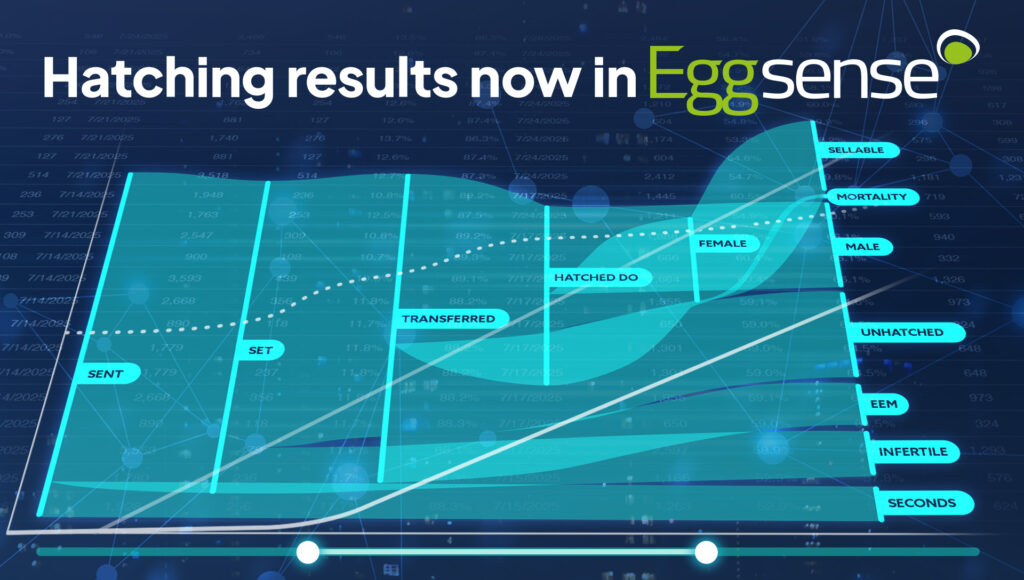
Eggsense already gives commercial laying flocks the ability to receive and analyse grading results from packing stations alongside their production data. We have now extended the same principle to parent and grandparent stock, allowing hatchery results to be brought directly into Eggsense and analysed alongside flock performance.
This gives breeder farms greater visibility of what happens to their hatching eggs and, importantly, provides a mechanism to understand how farm management and production performance can influence hatchery outcomes.
From hatchery results to meaningful insight
Hatchery results can now be analysed over the life of a flock, with data tables covering key hatchability and loss KPIs. Users can analyse production metrics against hatching results and benchmark performance across:
Farms
Sheds/houses
Flocks
Breeds
Breed standards
Eggbase field records
The system can also be used to create enterprise-specific breed standards from hatching results across farms, providing a valuable reference for hatchery planning and performance monitoring.
Getting the data into Eggsense
We work with each user to establish the most appropriate method of importing hatchery results.
Eggbase manages the creation of the import pipeline, making it possible to work with data from the systems already being used by hatcheries.
The functionality has also been incorporated into the Eggsense translation tool, making it available to users in different languages.
Connecting breeder performance with hatchery performance
Too often, breeder farms receive hatchery information as a weekly or monthly report, with limited opportunity to analyse what the results mean in relation to flock performance.
Bringing the data into Eggsense changes that.
Breeder and farm management teams can get timely insight into hatching egg performance and investigate relationships between hatchery results and factors such as:
Fertility and non-viable eggs
Male fertility
Egg size
Production performance
Environmental conditions
Temperature and humidity variation between sheds
For example, early analysis with hatchery users has highlighted interesting relationships between hatchery results and temperature and humidity variation in different sheds.
The objective is not simply to provide another hatchery report. It is to connect production data with hatchery outcomes, helping breeder teams understand where management, flock performance and hatching results come together.
Turning hatchery data into action
For parent and grandparent stock, whether broiler breeders or layer breeders, hatchery results are an important part of understanding overall breeder performance.
By bringing those results into Eggsense, the farm can move from simply receiving hatchery information to analysing, benchmarking and learning from it over the life of the flock.
This gives breeder teams a clearer view of performance and a mechanism to identify opportunities to improve outcomes.
